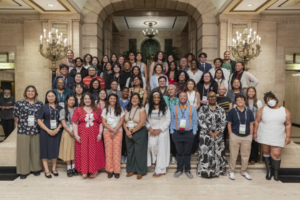
MLStEP is representing at the 2025 Annal Meeting of the Music Library Association! Maria Souliotis (Mountain-Plains Chapter Liaison) and Sarah Helen Carter (MLStEP Membership Officer and Midwest Chapter Liaison) will be presenting this week. We hope you can attend both sessions, and we look forward to seeing you there!
Indi Voices: A Living Discography of Indigenous American Music
Monday, March 17, 2025, 3:30 PM-4:25 PM ET
Speakers: Woody Colahan, Maria Souliotis, Thomas Bell
Abstract: Indigenous American nations have suffered genocidal violence, forced relocation, cultural destruction, loss of ancestral lands, and oppressive re-education since the colonization of the Americas by Europeans. Beginning in 1879 their children were forcibly removed to boarding schools, where they were forbidden to wear native dress, practice native spiritual beliefs, or even speak their own language, in an effort to completely eradicate indigenous culture. In addition to native dress, language, and spiritual practice, native boarding schools also prohibited indigenous music, which was and is central to indigenous culture, substituting Western art music in its place as a tool of forced assimilation. Despite this history of cultural suppression, indigenous Americans have continued to create music, continued to use music in healing and the construction of cultural identity, and continued to create new genres of musical expression such as chicken-scratch and peyote songs, and to adapt existing forms such as EDM and hip-hop for their own use.
Libraries can help to preserve the musical heritage of indigenous Americans by collecting and preserving recordings, as the University of Denver has done in response to its own problematic history, but discovering these resources is not easy. The most recent comprehensive discography of recordings by indigenous Americans was published by Greg Gombert in 1997, and the field has evolved substantially since then, with the appearance of new artists and new genres, and the re-issue of older recordings in new formats. This creates a pressing need for an up-to-date discographic resource to help libraries, enthusiasts and students of indigenous American musics to identify and access recordings.
Indi Voices is a web-based collaborative discography project conceived to meet this need. It is designed to be continuously updatable and never become obsolete. It aims to list all recordings issued since Gombert 1997, sorted by genre, nation, artist, and date; with each entry linked to a Worldcat record of library holdings. The index is browsable; the technological infrastructure is minimal; and the workflow is simple, scalable, and designed to encourage community collaboration. Our presentation will trace the history of suppression of indigenous musical culture, the discographical landscape of indigenous music, the design and structure of Indi Voices, and the project’s evolution to date. We will review our own positionalities as they are relevant to the project, share examples of contemporary indigenous music, and demonstrate in real time an update of the discography. We hope to raise awareness of the importance of indigenous musics, offer a model for creating a browsable online index, and encourage people interested in this work to become collaborators in the project.
Indi Voices is a collaborative act of anti-colonial resistance to cultural assimilation, in which we invite all to participate.
Learn by Fluting: Developing a Finding Aid for the Dayton C. Miller Collection as a Library of Congress Music Division Intern
Wednesday, March 19, 2025 at 4:30 PM-4:55 PM ET
Speaker: Sarah Helen Carter
Abstract:The Library of Congress Music Division’s Dayton C. Miller Collection is commonly considered the largest archival collection pertaining to the flute and flute-related instruments in the world. The collection, which came to the Division in 1942 at the bequest of scientist, flutist, and collector Dayton Clarence Miller, contains thousands of items in a variety of formats, including instruments, books, sheet music, correspondence, photographs, artwork, and statuary – representing a combination of Miller’s carefully curated flute collection, and his personal papers. This combination of size, age, and format variety has resulted in some parts of the collection being extremely well-documented and fully digitized, while other parts of the collection remain entirely unprocessed. As a summer intern in the Music Division with the unique opportunity to define my own internship project, I set out to create the framework for a finding aid that could bring a consistent baseline level of access to the entire collection. Along the way, I also had the opportunity to complete the sheet music series of that finding aid. This presentation will discuss how the process of creating a finding aid framework for the collection unfolded, as well as how the unique idiosyncrasies of the Miller Collection and my own perspective as a graduate student affected the project. In addition to providing a unique insight into a fascinating Music Division Collection, this presentation will also provide archivists with ideas to bring home to their institution’s most unwieldy collections and students with some inspiration to bring to their next internship!