I am Becca Fülöp, MLStEP co-chair & Atlantic chapter liaison. I’m the Performing Arts Librarian at Temple University, where I serve as liaison to the music, theater, and dance departments and oversee the Beyond the Notes concert series. This fall, I am thrilled to roll out the first stage of a project I started back in the fall of 2024: the Scores Discovery Bookmarks. Temple music students studying voice, violin, viola, and cello will be able to pick up bookmarks designed especially for them, with the aim of helping them to browse and discover music by instrumentation in the Charles Library stacks.

What do you do when you have a fantastic scores collection in your library, but students don’t seem to be using it? Through conversations with both students and faculty over the past few years, I have come to the frustrating realization that our scores collection is vastly underutilized, with students often preferring to find illegal copies of music online or even buy their own scores rather than using library copies. Some students don’t even know that the library has scores, and their studio teachers often fail to steer them towards the stacks when seeking out new music. With this problem in mind, I was inspired to embark on this project by two different presentations I had previously seen at AtMLA conferences: Jessica Grimmer and Michael Homme’s “Browsing Guides for Student Engagement in the Music Library” in 2022, and Christina Taylor Gibson, Adam Zukowski, and Michael Diener’s “Why Can’t I Search by Instrumentation?: Results from a Survey of Performers” in 2024. Grimmer and Homme’s delightful browsing guides, organized by instrument, showed me a way to create fun and informative tools designed for individual instruments, and Gibson et al. highlighted the need to make music discoverable by instrumentation. What if we made it easier for music students to use call number ranges to browse for music? The solution, I decided, was a discovery aid masquerading as fun swag. Bookmarks seemed like the obvious choice, and the Scores Discovery Bookmarks were born.
I had never attempted a project like this before, and I knew that in order even to have a chance of succeeding, I would need to find good collaborators and get buy-in from my department. I presented the idea to the library’s graphic designer Joi Waller, who was excited at the idea of a creative project so different from anything she had done before at Temple. She and I developed the idea, looking at bookmark templates from different vendors and deciding which would work best in terms of both design and pricing. We presented our idea to library administration and suggested that we ask the Boyer College of Music if they would agree to help pay for the bookmarks. The library administration agreed, and thankfully so did the assistant dean of Boyer. Vice Dean David Brown also helped me determine how many different bookmark designs would be needed (18, one for each instrument taught at Temple), and which instruments should be prioritized–voice and strings majors outnumber the other majors, so we started with those. We were ready to get started!
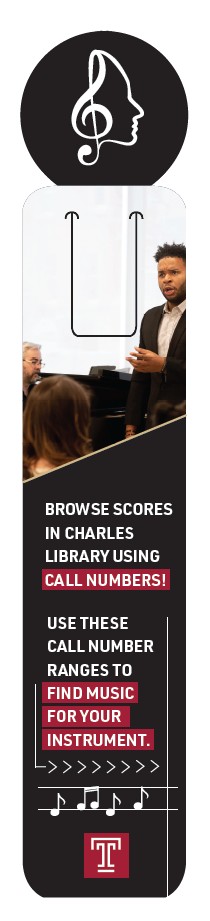
Actually getting started proved more challenging than I had expected. How was I going to figure out not only what ensembles and instrumentation should be included on the bookmarks, but also what those call number ranges were? The full schedule of LoC call numbers under “M” was not as helpful as I had hoped–rather than relying on its information, I found it helpful to search call number ranges in the catalog and compare that with what I found with the schedule. Through trial and error, I was able to narrow down which ranges most reliably held the scores students would be likely to look for, such as “Operas–vocal score” (M1503) and “Piano trios” (M310–M334). Joi’s early mockups showed me how much space we had for the list of call numbers, which was less than I had anticipated! I consulted with a few faculty voice and string faculty members, all of whom were enthusiastic about the project, but for the most part I relied on my own musical knowledge and common sense to pick which ranges should be included.
Once I had the copy I wanted to include, I was able to pass my materials off to Joi for the first draft of the voice bookmark. I had no idea what to expect! Using the bookmark template we had chosen, Joi made 4 different options of designs, all of them fantastic. I had my favorites, but I shared them with others in the library, especially colleagues whom I knew to be musicians. We decided on our favorite, made a few changes, checked the visual accessibility of the design, and Joi created a second draft. At this point I was also ready with the call numbers for violin, viola, and cello, and I suggested that Joi use the musical clefs associated with each instrument to help differentiate their logos. Before I knew it, we had the final drafts for all four instruments. All that remained was for Joi to submit the designs to the vendor for our order and liaise with the library and College of Music finance departments for payment.

While I was waiting for the bookmarks to arrive, I created a LibGuide to supplement the project. The guide not only contains expanded call number ranges for the existing bookmarks, but I’m also working on adding the remaining instruments so that the rest of our students have access to useful information for their instruments while waiting for their bookmarks. There are also pages with information on reading call numbers and using the online catalog to search call number ranges. Future bookmarks will have a QR code with a link to this guide.
Ordering the bookmarks took longer than I had hoped it would, as they first needed to be approved by the university. Luckily they arrived in time for an office hours session that I hold at the main music building, allowing me to distribute and advertise efficiently. Students and faculty responded enthusiastically to the bookmarks, with voice and string students quickly understanding their purpose. Other students appeared enthusiastic about the prospect of receiving their bookmarks in the near future, and I was also able to deliver batches to faculty members who will distribute them to their studios. I’ve also handed them out in some of the one-shot classes I’ve since taught.